Why Ohio May Be the Midterms' Surprise Swing State
A unique set of factors and eight figure ad buys could push the Buckeye State back into play

Why Ohio May Be the Midterms' Surprise Swing State
A unique set of factors and eight figure ad buys could push the Buckeye State back into play

Kim Lyons
September 24, 2026

Donald Trump carried Ohio all three times he ran for president, effectively ending its longtime status as a swing state in 2016 with his first win. For the past 15 years, Ohio has had a Republican governor and the GOP has controlled both houses of the state’s legislature. And with the 2024 defeat of Democratic stalwart Sherrod Brown, Ohio now has two Republicans representing it in the U.S. Senate.
But with an unpopular war in Iran, widespread economic uncertainty and gas prices set to skyrocket in the Midwest with just weeks to go before the midterm elections, Ohio looks ready to swing once again, and end years of GOP dominance.
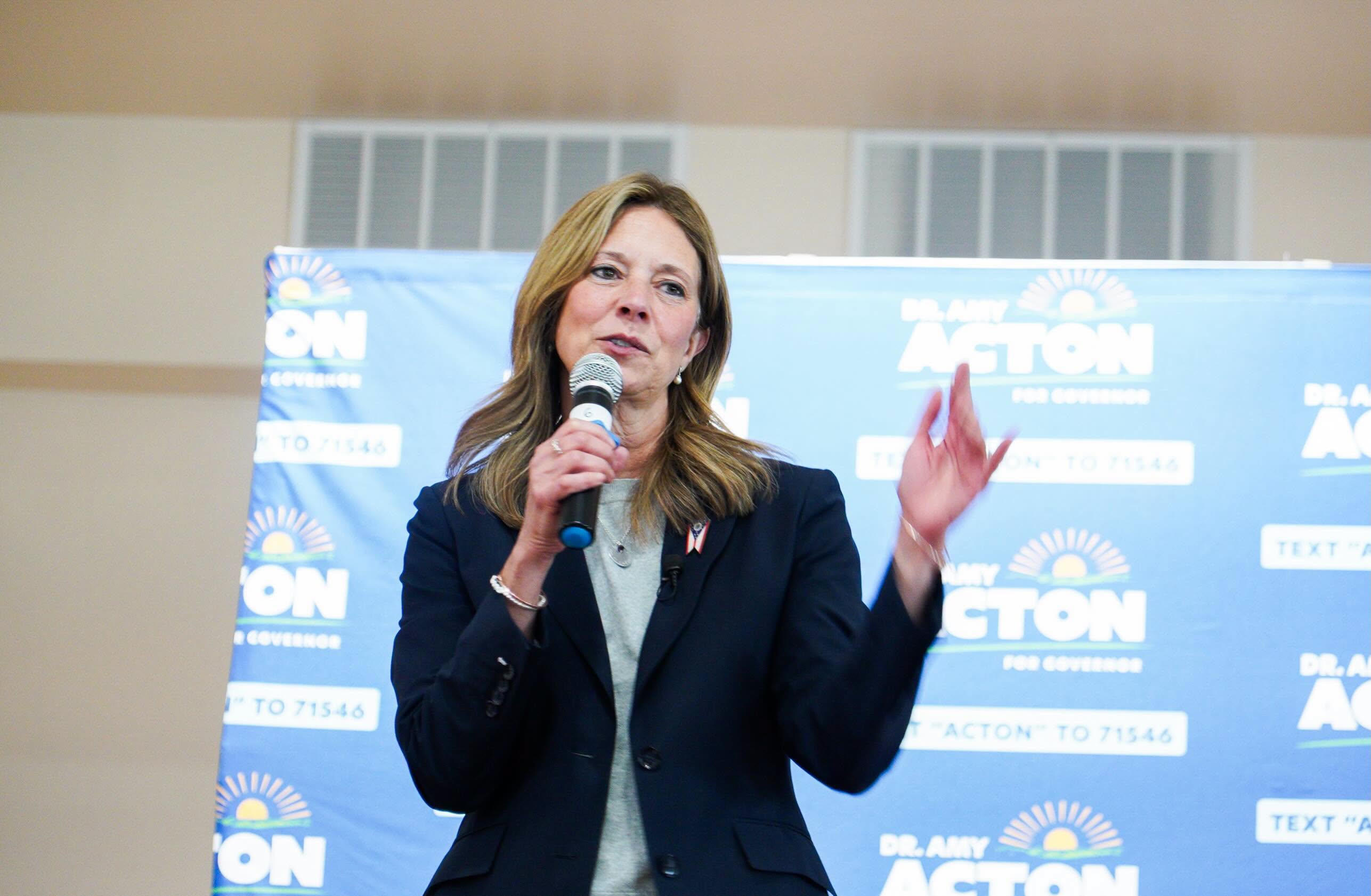
“It certainly for 2026 has become a swing state,” said Professor Emeritus Paul Beck of the Ohio State University political science department. The top-of-ticket race for governor, between Democrat Dr. Amy Acton and Republican Vivek Ramaswamy, and the U.S. Senate race between Brown and Republican Sen. Jon Husted, have mostly been too close to call, Beck said.
A Sept. 16 YouGov/Bowling Green University poll of 1,000 likely Ohio voters found Acton with a three-point lead over Ramaswamy. The same poll found Brown with a similar small lead over Husted. Both leads fall within the poll’s 3.96% margin of error.
But, Beck noted, Republicans are spending unprecedented amounts of money on Ohio campaigns heading into the midterms. The Senate Leadership Fund, a super PAC for Senate Republicans, said in April it was spending $79 million of its nearly $300 million war chest on Husted’s race, more than the PAC pledged to spend on any other state this cycle.
“That’s a sign of a swing state, that they think money can really change the outcome of the election.” Beck said. And while that’s possible, Beck added, he doesn’t think the additional spending will affect the Senate and gubernatorial races too much, since the candidates are already highly visible. “It may end up being a waste of money.”
How gerrymandering helped make Ohio look redder than it is
Gerrymandering, or the process of redrawing legislative districts to favor one party over another, has become something of a tradition in Ohio politics over the last decade. Voters approved — by a wide margin — an amendment to the state constitution in 2015 to change how Ohio draws its legislative districts. But rather than an independent body, the state wound up with an Ohio Redistricting Commission made up of mostly Republican appointees. The redistricting commission has disregarded state Supreme Court rulings against its proposed district maps, which said the districts were unconstitutionally gerrymandered.
“The state legislature has defied the Supreme Court of Ohio that has said these gerrymanders are unconstitutional, but they've gone ahead and enacted them anyway,” Beck said. “Once you've gerrymandered, the gerrymandered legislature, at least in Ohio, is the one that sets the district the next time around. And so it's a continuing problem.”
But the antics may have finally caught up with the dominant party this year, he added. “When you gerrymander, you dilute the strength of the districts that are your own districts, naturally, to be able to win additional districts,” he said. However, if a party encounters strong headwinds, as looks to be the case now, “by moving one district two points in your favor, let's say, you have allowed the opposition party to be able to win that district in a year where the swing is in the direction of the opposition party, and that could happen.”
Add to that random events that aren’t tied to gerrymandering, and the party in power could see its lead erode even further, even if it means the loss of just one seat. Beck pointed to the scandal surrounding Rep. Max Miller in OH-07. Miller is accused of abuse by his ex-wife and other women, but ignored calls from within his own party to drop out of the race. Beck said the situation threatens Miller’s incumbency.
“A Republican senator, the father of Miller's ex-wife, has said Miller should resign his office,” Beck said, referring to GOP Sen. Bernie Moreno, who defeated Brown in 2024. “That's really unusual. And so I think that Miller is going to lose that race in a district that he should not have lost under ordinary circumstances. But circumstances, of course, are not ordinary.”
Corruption, affordability and data centers
Acton, who served as Ohio’ health secretary during the pandemic, has recently focused her campaign messaging on fighting the corruption that has come to define Ohio politics in recent years: Former Ohio House Speaker Larry Householder, a Republican, is serving a 20-year prison sentence for his role in the FirstEnergy bribery scheme that resulted in legislation that forced Ohio ratepayers to support the company’s failing power plants. He faces a state trial on charges related to the scheme in March 2027.
Husted, the state’s former lieutenant governor, was appointed to serve out the term of JD Vance when Vance was elected vice president. Husted was never accused in the FirstEnergy bribery scheme, but had to testify earlier this year in the trials of two executives accused in the matter.
“How responsible he was for it is, I think, questionable to some degree, but he clearly was somebody who was backing the legislative bill that enabled these kinds of rate increases,” Beck said.
Beck said he was a little surprised that corruption wasn’t a bigger issue earlier in this cycle’s Ohio campaigns. “Republicans, particularly in the legislature, have been in control for years and years and years, and it's led to some real corruption,” he said, pointing to the FirstEnergy scheme.
He expects Ohio will begin to see more anti-corruption messaging from Acton and Brown heading into the final stretch, as the electorate has shown a growing anti-corruption sentiment. “It could be a real advantage for the Democrats,” he said. “If you're in charge, corruption plays against you, particularly as it becomes an issue, and I think that could happen in ’26, and even carry over into 2028.”
Brown, who lost in 2024 amid widespread discontent with Democrats over the state of the country’s economy, is banking on similar unhappiness with the current economic climate under Trump to help return him to the Senate. His campaign ads have railed against Husted’s past support of widely unpopular AI data centers in Ohio, an issue that a leaked memo from the National Republican Senatorial Committee called an “anchor hanging around Husted’s neck.”
Ohio is in the top five among states with the most operational data centers. And there are more than 100 moratoriums in communities across the state to stop new data centers from being built.
Beck said data centers arising as an issue isn’t something anyone could have predicted a year or two ago. “There's a populist reaction on both the left and the right, a feeling in many communities that they're being dictated to, that their political leaders have kind of sold them out on this,” he said. “Sold them out in two ways: One is allowing the data centers to be created there in the first place, but secondly, providing almost massive tax rebates to encourage data centers to locate there.”
The other issue dominating the conversation among 2026 voters, including in Ohio, is affordability. “Voters see this at the grocery store, they drive by the gas pumps every day,” and wonder if they should fill up their tanks,” Beck said. “There's no sign that the gasoline prices and oil prices in general are going to abate.”
Farmers in Ohio and other states with large rural farmland are being particularly hard hit, he noted, since many rely on fertilizer, whose cost is affected by oil prices, and diesel powered farm equipment.
The Trump factor
Ramaswamy received an early endorsement from the president, but it’s not clear how much it’s helped his campaign, which has struggled with several self-inflicted gaffes. Ramaswamy, whose political career includes a brief run for president and a short stint as part of Elon Musk’s DOGE team, was booed off the stage in Cleveland during a student libertarian convention in July, where he told the audience divide in American politics was between “winners and whiners.”
Earlier this month, his campaign deleted a social media video showing him taking some questionable swings at a baseball batting cage. And Ramaswamy’s role at a company that pushed a drug for Alzheimer’s treatment that was found ineffective was the focus of one of Acton’s recent campaign ads.
In the You Gov/Bowling Green poll, 60% of respondents said they somewhat or strongly disapprove of the job Trump is doing as president — just two years after he won Ohio by 11 points. And with the president’s popularity sagging, his endorsement may not help Ramaswamy or Husted, who Trump endorsed in April 2025.
Beck believes discontent with the president may lead a lot of his previously loyal voters in Ohio to stay home on Election Day. “Donald Trump is dominating this election,” he said. While the president's approval rating in Ohio isn’t quite as low as it is nationally, he noted, it’s sharply worse than it was at the start of his second term.
“The effect of that, I think, is to kind of demobilize, discourage MAGA followers, and lead them perhaps not to vote in a midterm election,” Beck said.
Will Ohio remain a swing state in 2028?
If Ohio does in fact swing back to Democrats in November, Beck says the state will likely continue as a swing state into the 2028 presidential election. The party will have momentum and visibility it has not had in recent years at the state level, making it easier to recruit volunteers and raise money.
“I believed in recent years that the Republican advantage in Ohio was basically exaggerated,” Beck said. “They had all these advantages in raising money and incumbency and the like, but they could be very, very quickly turned around by a Democratic year like 2026 seems to be shaping up to be.”